
The Mummy Rises

Hey guys, you heard about our Mummy? The Egyptian one, in the Baroda Museum? With a beautifully painted and decorated cover … Some fungus has got it, they say.
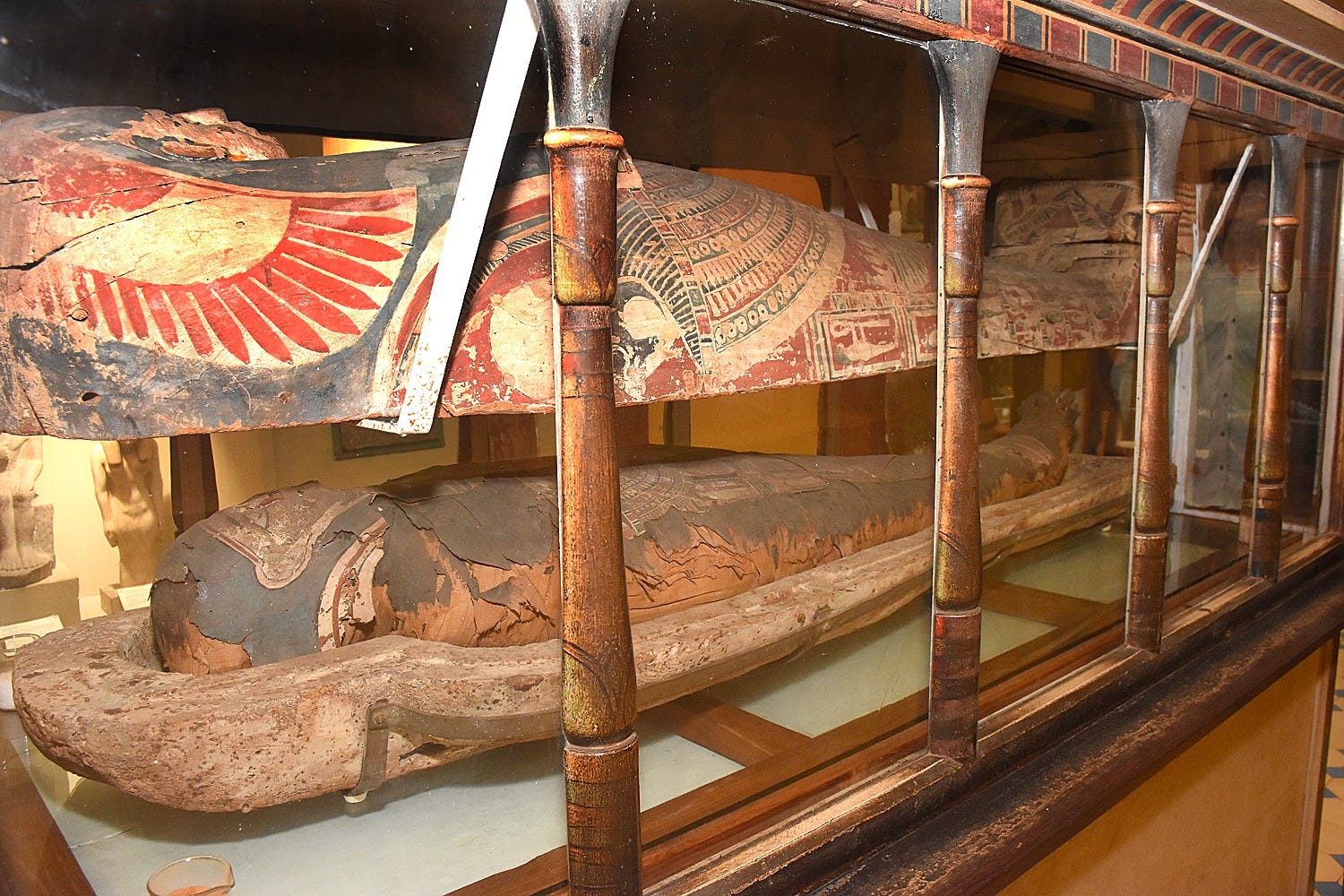
The Mummy in the Baroda Museum and Picture Gallery. Photo by Ashwin Rajput
As kids and teens (especially with visiting cousins from out-of-town, in tow), we all loved going to the Baroda Museum to gaze fascinated at the single Mummy in the Egyptian section on the first floor. In our collective mesmerized eyes, that Mummy was our small town’s claim to fame, as against the many delights offered by large cities that the cousins came from. No other Museum in India, as far as we knew then, had a Mummy as an exhibit, whether it was Mumbai or Pune. To the older amongst us, comics such as Tintin and the Seven Crystal Balls followed by Temple of the Sun where disturbing the Inca Mummy’s resting place by English/European explorers brings upon them curses and all kinds of troubles, added to the mystery and sense of danger that Mummies could wield. It was the closest we came to feeling like Blyton’s Famous Five for a few precious minutes!
We would all bunch together at the feet end of the Mummy, gazing in awe, mouths wide open, at the couple of knobbly, skeletal toes that stuck out of the numerous layers of fragile fabric that the Mummy was wrapped in tightly, like the newborns I saw in the hospital nursery when many years back my youngest sister was born and I was taken to visit my mother and the baby. The ‘sticking-out toes’ were a clear indication to us that there really was a dead human in there. How old could it be? Was it a man or a woman, a girl or a boy? The plaque by the side indicated it being more than 2500 years old. In our young minds, this number only meant it was alive and walking about ‘once upon a time, many centuries ago …’ No fairy tale could have been more engrossing!
Now the newspapers tell me it was these open toes that some ‘curious curator’ un-bandaged in 1950 (or thereabouts, nobody is sure), that could have allowed an infection called Alexandria fungus to settle in. For some reason this infection has not been treated, and so the Mummy is in danger of being reduced to a bag of bones, or worse still, a mound of dust, from its earlier elevated full body stretched and bandaged prime exhibit state was left untreated and it has been causing what is called, ‘biodeterioration’. (Sources at the Museum tell me that in 2001-02, when the fungus was first detected, a countrywide conference of museologists was hosted by the Baroda Museum along with an Egyptian expert especially flown in, who conducted workshops on how to manage fungal infections which are quite common in artefacts where organic material is used. At that time, this expert had examined the Baroda Mummy carefully and declared it was good to go for another century.)
The newspapers also tell me that five other Museums in India have Mummies as exhibits (including Mumbai’s Prince of Wales or Chhatrapati Shivaji Sangrahalaya, but thankfully the Mumbai cousins have no idea, so our small town’s claim to fame continues to hold its flag high). However, all of them are quite safe, and I hope scientists will be able to treat the Baroda Mummy successfully and it will continue to rest at the Museum for more centuries to come, delighting so many more kids, still not addicted to digital devices.
It was Maharaja Sayajirao who purchased this Mummy from New York in 1895 for US $175 and gifted it to the Baroda Museum & Picture Gallery. (To me, this came as quite a surprise – imagine being able to pick up a Mummy in the US! Just like that! I guess some US Museums may have bought them from Egypt in a bunch and there were a few extra lying about, so they went on the market. In fact, I am told two Mummies came to Baroda, one meant for another destination). If this Mummy is lost, I don’t think anyone else is going to help the Baroda Museum replace it with another.
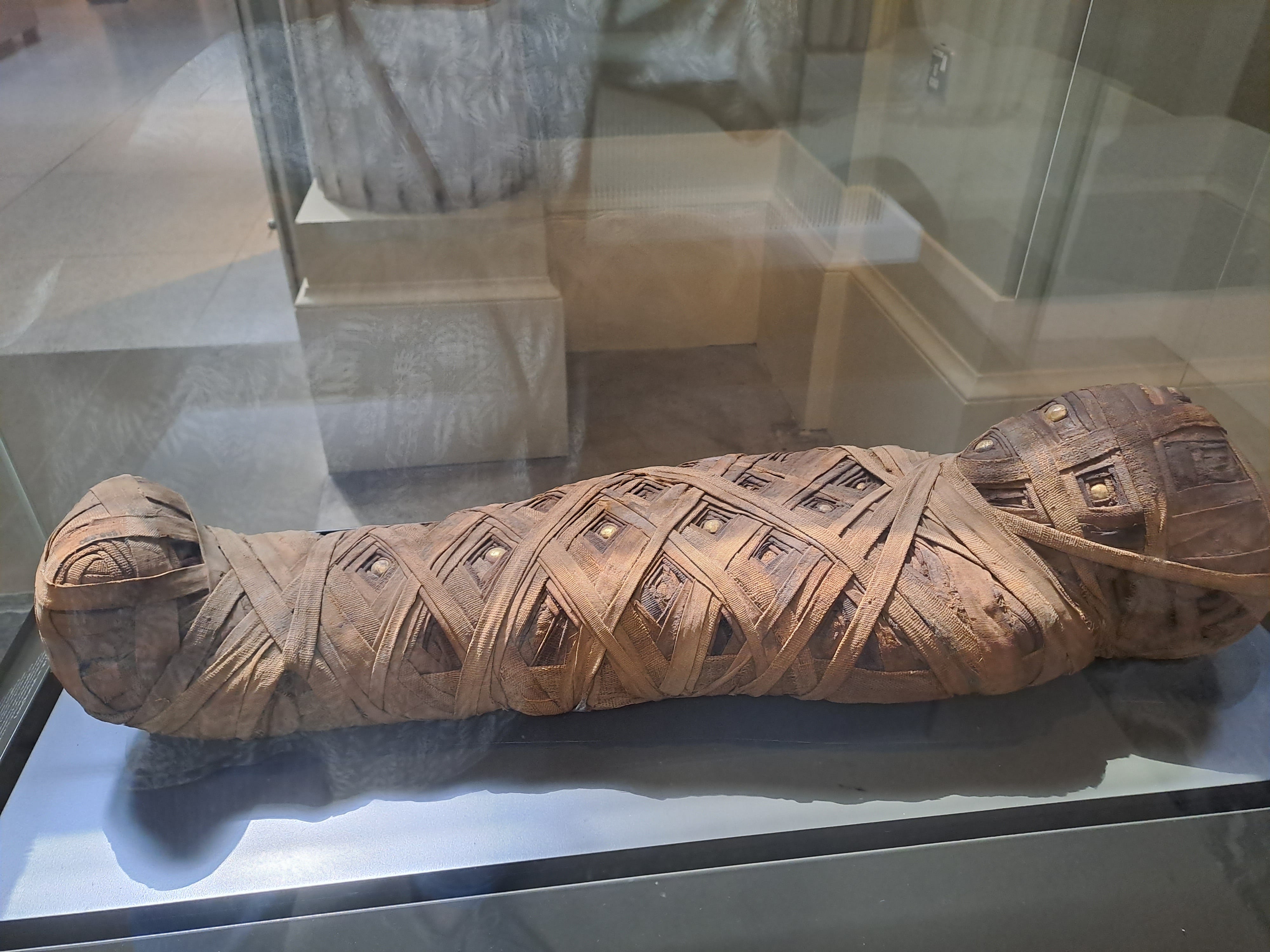
The Ashmolean Mummy Boy. He is wrapped to resemble Osiris. Some gilded studs survive on the linen wrappings. From the cemetery at Hawara, Fayum, Roman (about AD 100) Flinders Petrie excavations. The Ashmolean Museum, Oxford.
It is amazing how many Museums, large and small, across the world have been blessed by wondrous collections of artefacts from the 5000-year old Egyptian civilization (our time, as we know it, is 2022 going on 2023 years old; make the comparison).
The Louvre in Paris, the British Museum in London, The Metropolitan in New York, for example, have committed huge spaces especially designed for appropriate display of the Egyptian treasures that are in their collection. The Egyptian section at the Louvre can easily take two days to cover for the interested visitor. There must be scores of smaller Museums, such as the Ashmolean in Oxford, UK, that must be home to modest but very significant collections, and perhaps hundreds of even smaller Museums such as the Baroda Museum that house a miniscule collection but where that collection really catapults that museum into one of some importance for scholars from myriad disciplines.
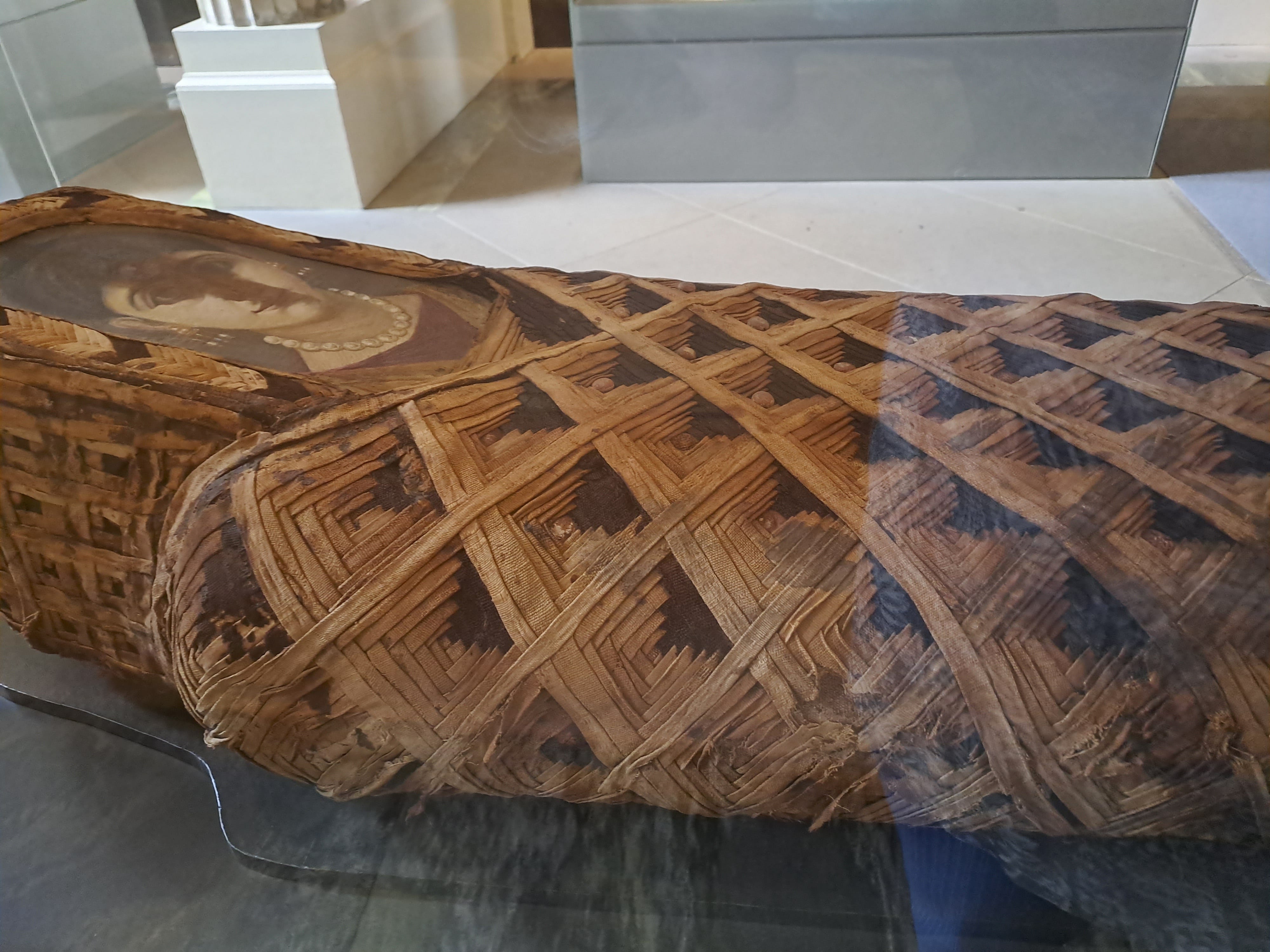
Mummy of a young woman. The woman’s portrait is painted in encaustic on limewood. Her turban-like hair style, clothes and jewellery are inspired by Roman court fashions. From the cemetery at Hawara, Fayum, Roman (about AD 130-140). Flinders Petrie excavations. The Ashmolean Museum, Oxford.
Since I visited the Ashmolean just recently, those memories are fresher in the head. The Egyptian section here sprawls over just a smallish floor but the displayed objects are superbly selected with just the right space between them, so one does not overpower the other. The overdose of images here are just to prove this.
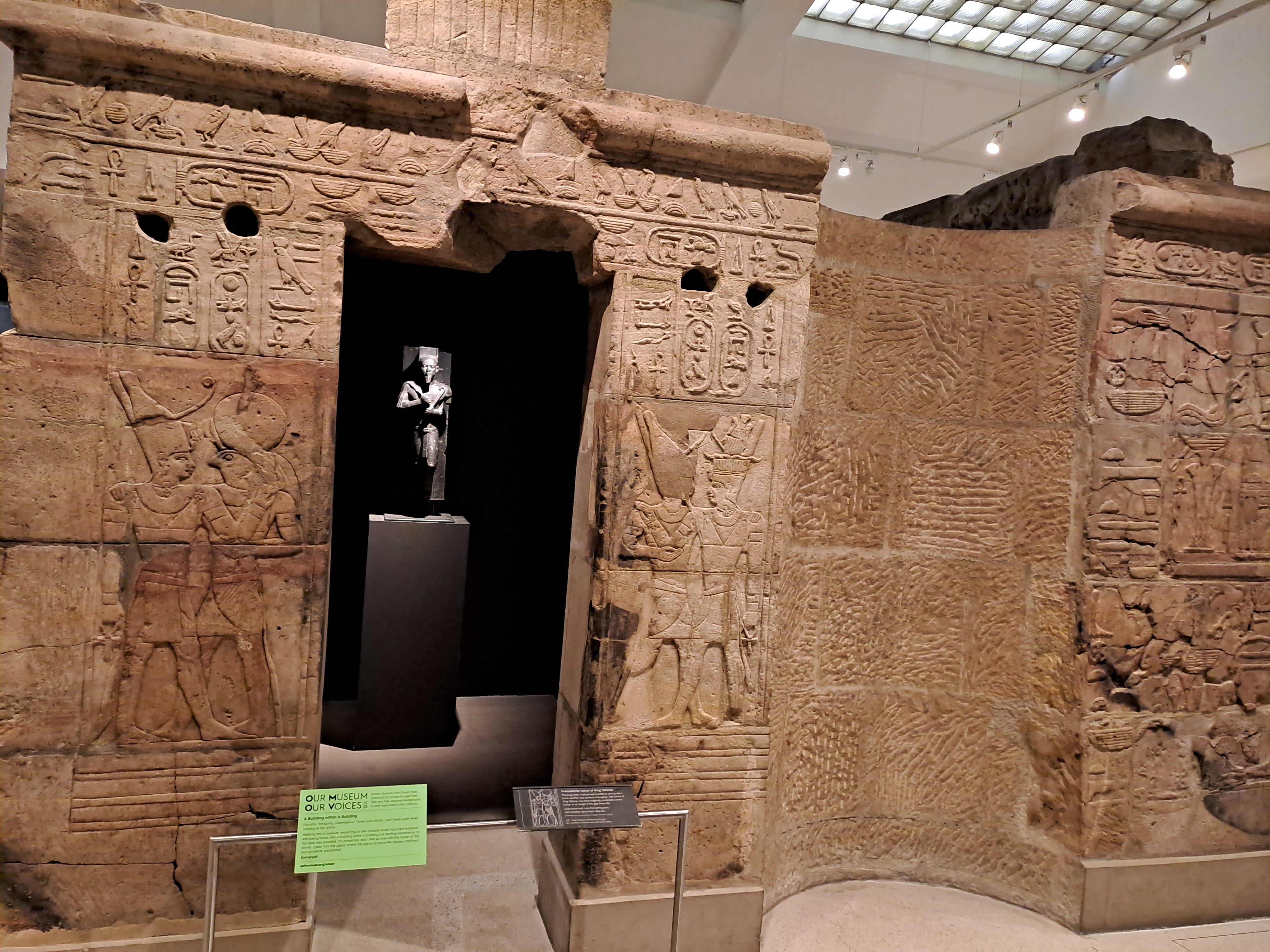
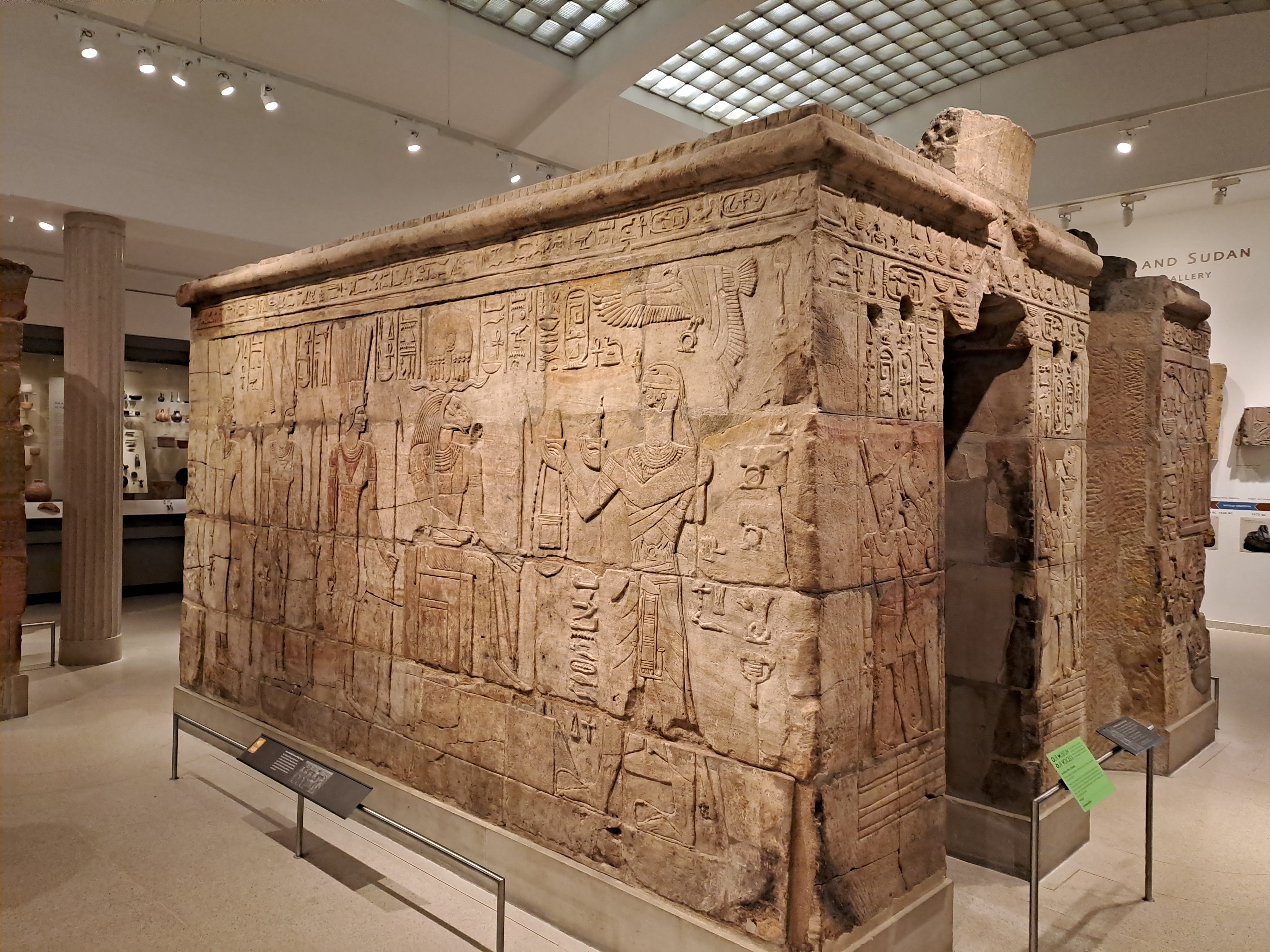
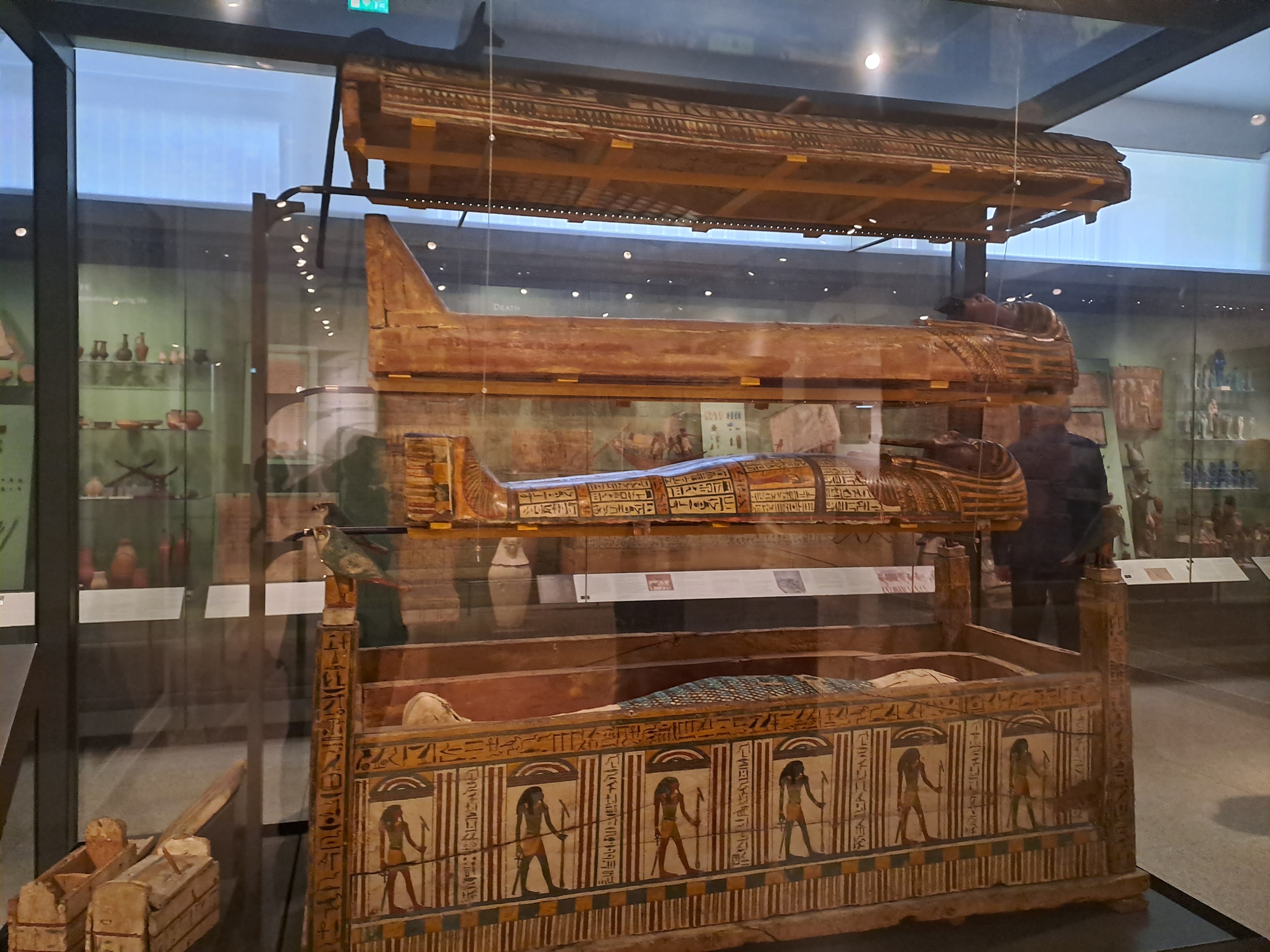
Some of the larger installations at the Ashmolean.
They also raise other questions. Napoleon’s invasion of Egypt in 1798 is believed to have sparked the interest of Western adventurers, history-academicians, funder-mercenaries, particularly in its antiquities. A French officer, Bouchard, discovered the Rosetta Stone there (now in the British Museum) in July 1799. Another Frenchman, Champollion, broke the code of the Rosetta Stone with its Egyptian hieroglyphs, ancient Greek and Demotic (a form of Egyptian script in cursive form). By the early-1880s, there was a virtual invasion of Egypt from British and European (perhaps, American too) explorers with funding to drive their discovery expeditions and excavations. Hydraulic and engineering skills available in these countries helped these teams to transport their finds to Cairo and Alexandria and from there to London, Paris or wherever. Believe it or not, excavations continue to this day though since the early-20th century, the Egyptian Ministry of Antiquities is very much in the picture. We still do not have a complete picture of what this magnificent civilization has on offer!
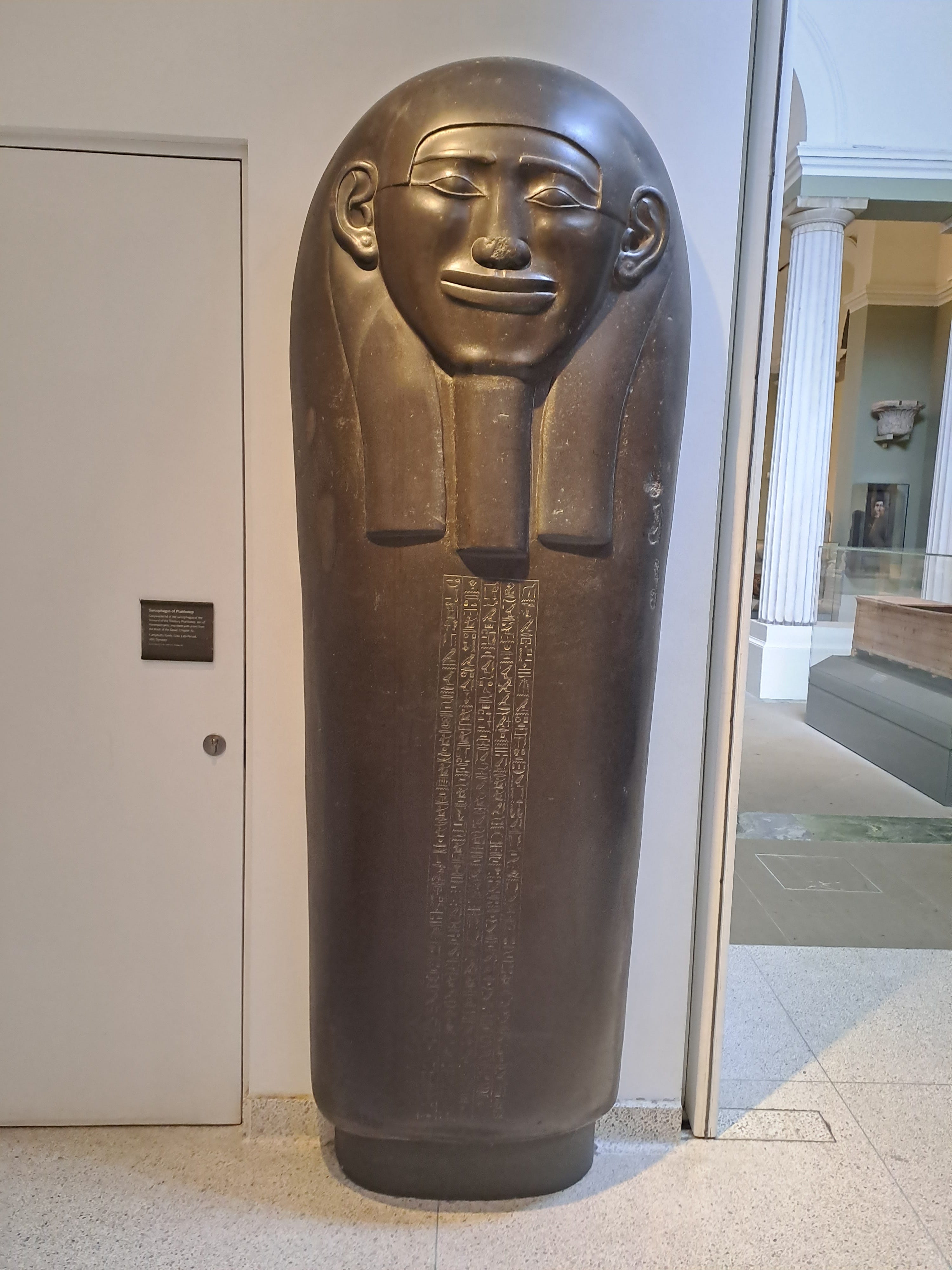
Sarcophagus of Ptahhotep. Greywacke lid of the sarcophagus, inscribed with a text from the Book of the Dead, Chapter 72. Campbell’s tomb, Giza, Late Period, 26th dynasty. The Ashmolean Museum, Oxford.
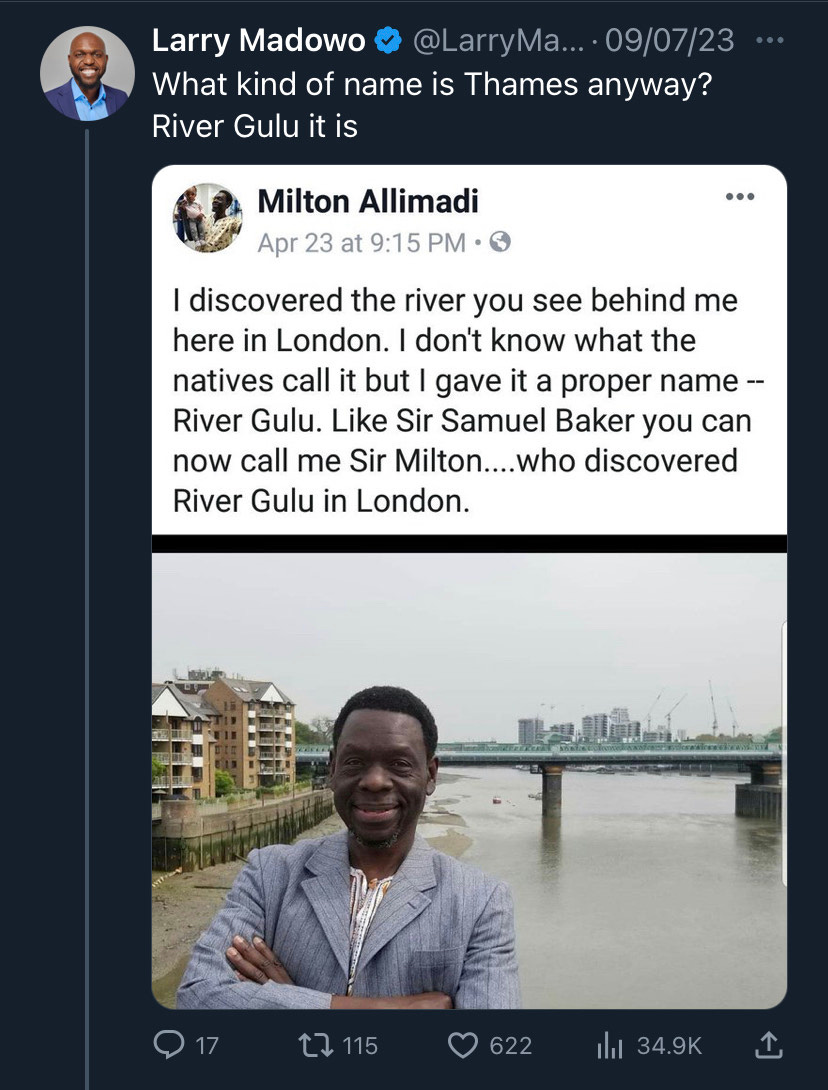
The next point of conflict is the continuing debate of whether the Western world should return the treasures from the various countries across the world that the colonizers ‘looted’ from it. This debate has many sides to it, a number of them very serious indeed. But let me end on a lighter note …
You/your writings continue to amaze me.
Enjoyed it.
I rarely miss Egyptian galleries whenever I visit a great museum abroad who invariably have Egyptian objects. Since I can’t post them here, I am forwarding some from the Museum if Fine Arts in Boston I visited recently to Sandhya on WhatsApp.